Communications
Crisis
Leadership
Sugarman Occupational Health had been acquired out of administration and brought into a human capital portfolio, separating it from a much larger recruitment and service provision business it had previously sat within. While the business was growing, it carried a number of inherited challenges — both reputational and structural — that limited its ability to compete confidently in the market.
Under previous ownership, the brand had developed a perception of being cut-price and inconsistent in service quality. The Sugarman name was also shared with other businesses that were no longer under the same management, creating confusion in the market and making it difficult to establish clear ownership of the proposition. Visually, the brand had not evolved for over a decade, and elements of the identity no longer aligned with the values, ambition or tone of the new owner.
Commercially, the business faced a further challenge. It had a number of large, high-value clients, but customer acquisition was slow and reliant on long sales cycles. Despite operating in a market where flexibility and responsiveness were genuine strengths, these were not being articulated clearly or consistently — limiting awareness, inbound demand, and the ability to support growth in a more challenging economic environment.
I approached this as a reputational reset and growth challenge, not a cosmetic brand refresh. The priority was to modernise the brand in a way that reflected the new ownership and ambition of the business, while rebuilding credibility in a market where trust and professionalism matter deeply.
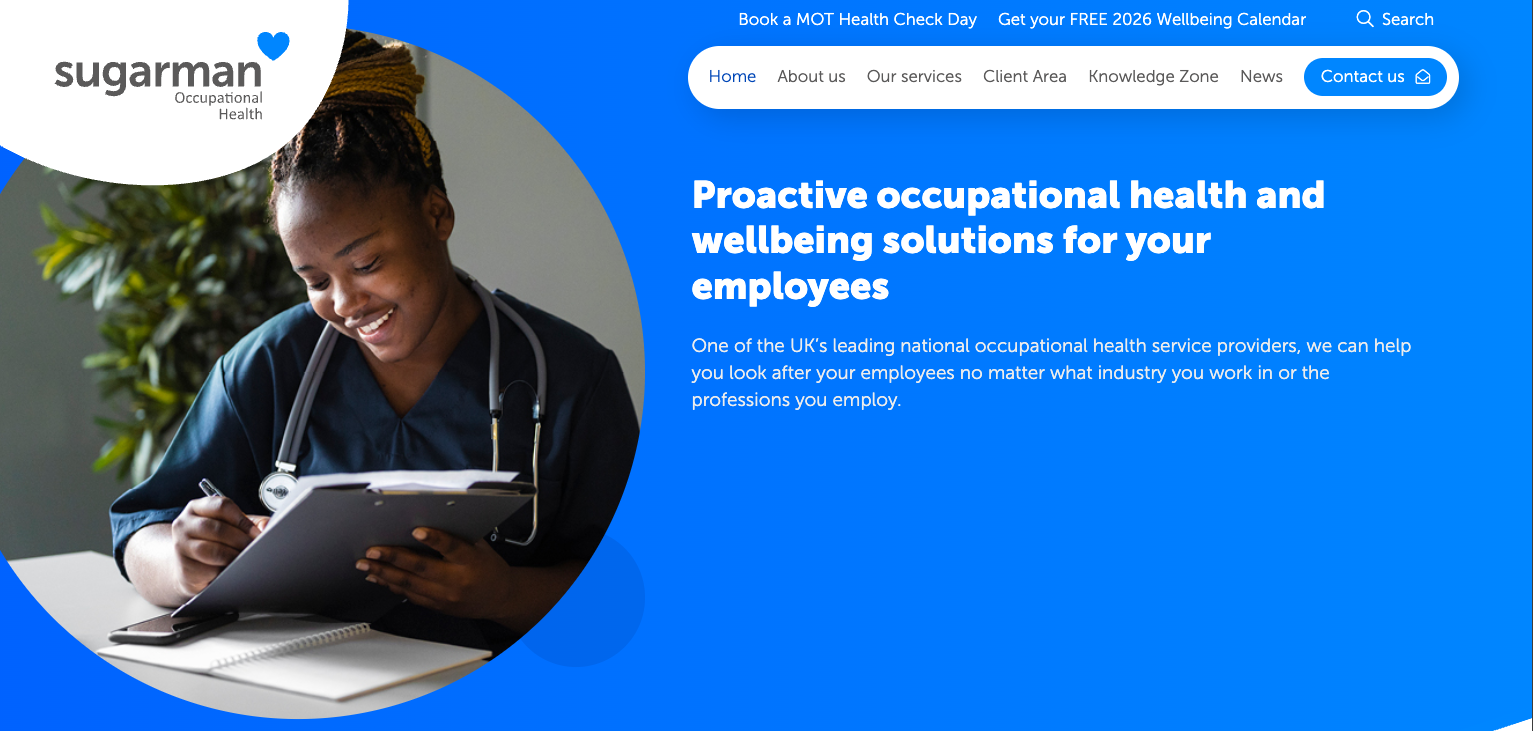
The first step was to refresh the brand identity itself — evolving it rather than discarding it. The design was modernised and subtly aligned with the wider portfolio, retaining familiarity where it still had value but removing elements that felt dated or no longer appropriate. This created a clearer, more confident foundation without unsettling existing clients or contacts.
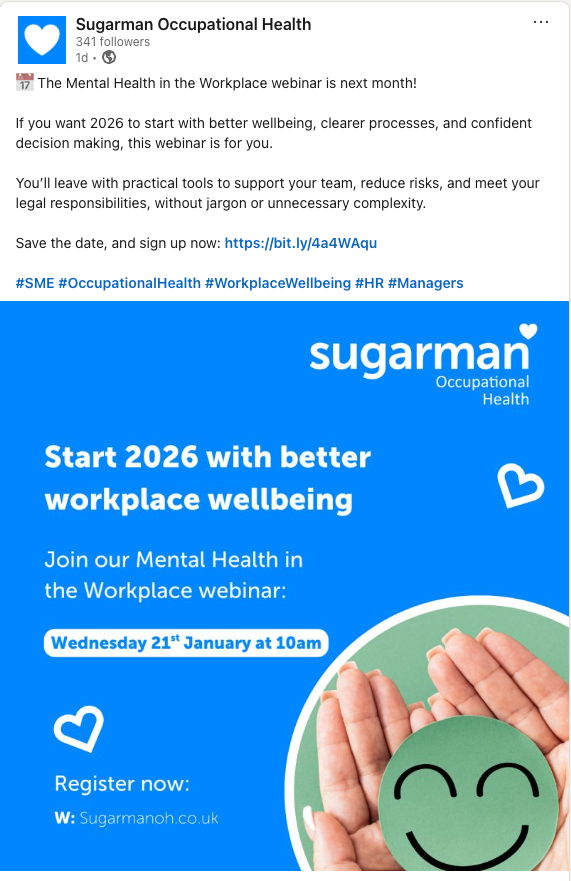
Alongside the visual refresh, I developed a new content-led marketing strategy designed to support long-term growth rather than short-term promotion. This focused on consistent, high-quality content across social media, email marketing and the website — positioning Sugarman Occupational Health as knowledgeable, practical and approachable. Physical collateral, including wellbeing calendars and similar resources, became part of this strategy, providing value to clients and non-clients alike and reinforcing presence beyond digital channels.
A detailed market review identified a significant positioning opportunity. While most occupational health providers offer pay-as-you-go services for smaller employers, very few actively market this flexibility. The strategy repositioned Sugarman Occupational Health as the flexible option — supporting organisations from as-and-when PAYG support, through small packages as they grow, up to a full-service occupational health offer for larger employers. This reframed the business from a single-point provider into a long-term partner.
To support this, I designed and implemented a clear lead generation and nurture pipeline. Campaigns were deliberately value-led rather than sales-driven, focused on being visible, helpful and present — “we’re here when you need us” — while building momentum towards conversion. I also developed a forward-looking plan for the next phase of growth, including educational content such as an occupational health podcast and webinars for managers and employers, ensuring the strategy could continue to evolve beyond the initial reset.
A credible brand reset delivered. The refreshed identity modernised Sugarman Occupational Health, aligned it with the wider portfolio, and removed legacy signals that had undermined confidence — without disrupting existing relationships.
Clear positioning unlocked growth. Reframing the business as a flexible occupational health partner — from PAYG support through to full-service provision — clarified the offer and made it easier for smaller employers to engage earlier in their growth journey.
Inbound demand increased materially. Online lead generation more than doubled, supported by a clear conversion pipeline that moved prospects from awareness to enquiry in a structured, measurable way.
Marketing shifted from promotion to value. Content-led campaigns, nurture journeys and physical collateral established a consistent presence in the market, focused on usefulness and trust rather than hard sell.
Momentum sustained beyond launch. A clear forward plan was put in place for the next phase of growth, including educational content such as webinars and an occupational health podcast, ensuring the strategy continued to build credibility and demand over time.
A stronger platform for growth created. The business emerged with clearer positioning, improved reputation, and a scalable marketing approach suited to a market where sales cycles are long and trust is critical.